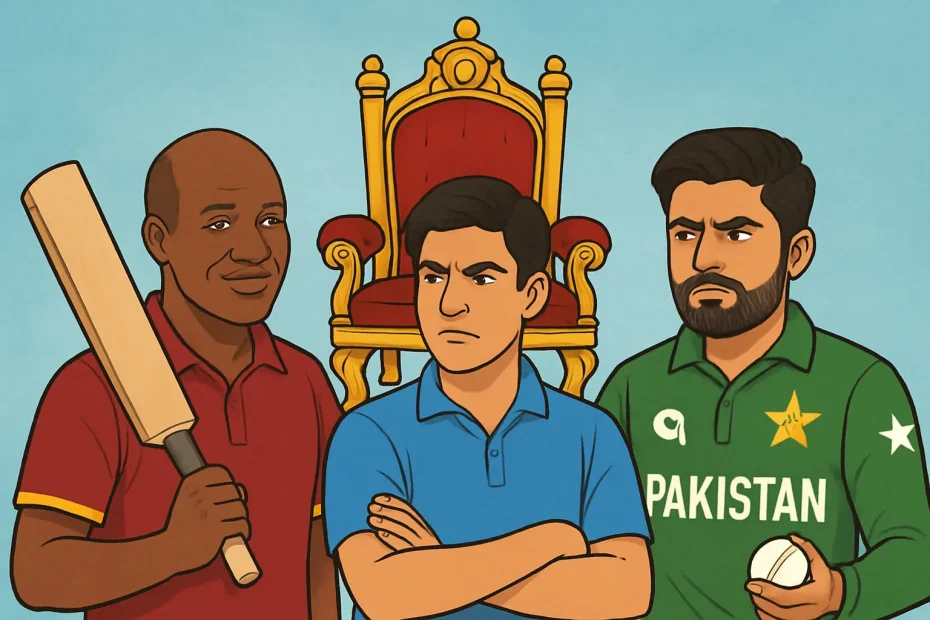
Shubman Gill stands as the most widely accepted Prince of Indian cricket today, Brian Lara remains the original Prince of Port of Spain and the enduring archetype, and many fans in Pakistan describe Babar Azam as the shahzada e cricket or prince of Pakistan cricket. The title moves through eras and regions, tethered to elegance, authority, and a sense that the next drive could stop time.
The words prince of cricket carry weight beyond a nickname. They speak to an aesthetic, a posture at the crease, the shimmer of promise delivered repeatedly under pressure. A prince is not the king or the god of cricket; he is the heir and the artist, equal parts possibility and proof. The list evolves with form and memory, but the crown usually finds a batter whose shape and sequence scream inevitability long before the scoreboard catches up.
Understanding the Title: What Prince of Cricket Really Means
The modern reader sees the phrase used for multiple cricketers, yet the idea has a distinct texture. Prince of cricket signals:
- Shot aesthetics that feel inevitable, not improvised.
- A temperament that frames the innings, rather than fills it.
- Versatility across formats, with particular glow in high-viewership cricket.
- Cultural resonance that builds legends and hashtags in equal measure.
- A signature stroke that becomes shorthand: the cover drive, the back-foot punch, the on-drive that melts through mid-on.
It is theatre and technique, both. And the crown tends to land on the heads of batters who make purists argue and casual fans point at the TV with a grin and a single word: class.
Brian Lara: The Original Prince of Port of Spain
Among all nicknames in cricket, the Prince of Port of Spain sits nearest to canon. Brian Charles Lara, left-handed sorcerer from Trinidad, claimed the phrase early and wore it lightly. Port of Spain is his birthplace and spiritual home, and the moniker came to represent more than geography. It meant the romance of his backlift, the way bat speed and hands found gaps imagined by few.
Meaning and city
Prince of Port of Spain means Lara’s sovereign relationship with Trinidad’s capital and with Caribbean cricket. He was not a ceremonial figure. He was the spark that lit stadiums, the artist who rebuilt identity after West Indian dominance began to fade. The prince imagery fit his gait, his composure, and the way Caribbean crowds received him: as an heir to greatness who frequently delivered on the promise.
The art of the high backlift
Technicians still chart Lara’s backlift as a template for an audacious player who wants freedom without chaos. The bat sets early, the movements are elastic, and the weight transfer is a dance between patience and burst. When bowlers aimed fourth-stump lines, Lara’s hands could wait and then crack the gap through point. When they attacked the pads, the flick came with wrists that turned on a hinge. Bowlers adjusted lengths, fields spread, and the scoreboard continued to tick. Spin bowlers, even the greats, found his geometry unsettling. When he skipped down to on-drive a length ball against spin, the line often looked respectable, the result felt inevitable.
The 400 not out story and why it still matters
A single innings lodged Lara forever in cricket folklore: 400 not out, the highest individual Test score in history. The scale of that feat sits in the mind for two reasons. First, the capacity to keep clarity for so many deliveries without losing ambition. Second, the situational control that allowed West Indies to assert rather than simply survive. Long-form batting of that scale asks a player to become both metronome and canvas. Lara did it with flair left intact, not ground down by repetition. Add to that his unbeaten 501 in county cricket, and you get the rare player who has monuments in both the international and domestic worlds.
Lara versus Tendulkar, the prince versus the god
The great debate, evergreen in cricket rooms everywhere. Sachin Tendulkar became, for many, the god of cricket: consistent, relentless, precise. Brian Lara became the prince: mercurial, match-shaping, unapologetically romantic in style. Numbers favor both in various ways, but the split in symbolic roles helped the title settle: god for the unshakeable gold standard, prince for the audacious genius who can rewrite a day’s mood. The world had enough space for both archetypes, and that duality helped the term prince of cricket gain texture and permanence.
Brian Lara records in Test and ODI cricket feel like a museum of audacity: triple hundreds, that surpassing 400 not out, ODI magic where the whip and late cut became calling cards. When conversations about the prince of cricket in world cricket take a historical turn, the path winds back to Lara more often than not.
Shubman Gill: The Modern Prince of Indian Cricket
The phrase prince of Indian cricket, for this era, fits Shubman Gill for a host of reasons. He owns the cover drive that makes highlight reels hum. He brings a spine to top orders without losing stroke-play identity. He has stood up as an opener in international cricket and as a run-magnet in franchise play. And he exudes the calm of a batter who knows he belongs.
Why Shubman Gill is called the prince of cricket
The case rests on aesthetics plus production. Gill’s cover drive, front shoulder aligned, wrists soft, elbow high, is the poster image. The bat path holds its line long enough to feel like a melody. Fielders at extra cover have learned to measure the margins in inches. On good batting tracks, Gill can accelerate without visible risk. When seamers go wide of off, he rides bounce with economy. When spinners slow pace, he stays leg-side of the ball just enough to keep placement options alive.
India in this period needed an heir to the throne at the top of the order, someone who could link eras. The moniker prince of cricket attached naturally as Gill moved from prodigy to pillar.
Shubman Gill’s format identity and milestones
Shubman Gill has tasted signature peaks in each format, a key pillar of his princely profile.
- In ODIs, he struck a double hundred, one of only a handful of Indians to do so. That single innings, combined with a long run of top-order reliability, gave him audience approval and algorithmic fame in equal measure.
- In Tests, he has produced hundreds on home soil and outside, with a strike rotation that continues to sharpen. The short-arm pull and on-drive against pace have become tactical levers rather than flourishes.
- In T20Is, he owns a hundred that arrived with the kind of effortless acceleration rare at that level. The mechanics were simple: a flurry of range hitting built from conventional shapes, not slog-first thinking.
- In the IPL, he crafted an Orange Cap season with Gujarat Titans, asserting himself as a long-innings T20 player who does not need high-risk shuffles early to set a platform. Later, he took on leadership responsibility and showed ice in his in-game management, field changes, and bowling usage.
Table: Shubman Gill’s format snapshot
| Format | Typical role | Primary gears | Go-to strokes | Notable milestones |
|---|---|---|---|---|
| Test | Top-order anchor with range | Start compact, expand in third session | Cover drive, back-foot punch, on-drive off seam | Overseas hundreds, series-defining innings at home |
| ODI | Aggressive opener, phase-2 dominator | Risk-managed power during middle overs | Square drive, pick-up over midwicket, lofted extra cover | Double hundred, multi-ton tournament runs |
| T20I | Top-order accelerator | Conventional stroke power scaling to 160+ tempo | Upright lofts over long-off, late cut vs pace-off | Format century with dominant strike phases |
| IPL | Franchise spearhead and leader | Controlled powerplay, ruthless middle-tableau | Inside-out shots vs spin, “wait-hit” square shots vs pace | Orange Cap season, playoff-defining knocks |
The Gill method, in short form
The initial movement is minimal. Gill prefers balance and late decisions over big premeditation. Against right-arm pace from over the wicket, he presents a firm front pad to kill LBW risk early, then opens the bat face to beat point or, when narrower, rides the seam into wide mid-off. On slower surfaces, he starts earlier but keeps the hands soft, letting the bat path carry the ball, not battering it. He does not chase wide length balls in the first over-by-over cycle; he makes bowlers come to him.
Where Gill must evolve
- Spin-strike rotation on two-paced pitches must remain a practice obsession, especially when matchups force him to farm singles into the leg side with more risk than he would like.
- The pull against high pace has improved, but he still benefits from a rehearsed bail-out option outside off, a shot that brings him runs without opening a technical door for the opponent.
- In chases, his decision to shift from gear two to gear four needs to be timed with dew and field positions, something he is reading better with every season.
Shubman Gill vs Virat Kohli: Prince vs King
Virat Kohli, the King of cricket for many across formats, built his rule on tempo control, chase mastery, and ruthless repeatability. His cover drive is iconography, his short-arm jab is a middle-overs cheat code, and his ODI chase record elevated execution into myth. Shubman Gill, the Prince, draws from that blueprint while retaining a cooler visual rhythm.
- Kohli’s power comes from intent density and obsessive fitness. He has long been the game’s exemplar of winning by accumulation made lethal at will.
- Gill’s power comes from elegance and structure that never looks hurried. His peaks may feel like gliding rather than grinding, but the output at his best sits in that same elite band.
When fans search shubman gill vs virat kohli who is prince of cricket, the answer feels straightforward: Kohli’s crown reads King; Gill’s reads Prince. Both matter. Both define eras. The titles signal different archetypes rather than a hierarchy of respect.
Shubman Gill cover drive highlights, technique in full view
Gill’s cover drive begins with an unhurried head position. He steps into line, not across it, keeps the front shoulder closed longer than most, and presents the bat at a steady angle. He does not slap; he leans. The wrists finish over the shoulder, not abbreviated. The key is his contact point slightly in front of the body, which ensures the ball runs hard enough to make deep extra cover a passenger. Broadcast slow-motion shots show how little he overhits, especially against good-length balls. For young players, this is a masterclass: strike late, align early.
Orange Cap season and leadership impressions
In his Orange Cap season with Gujarat Titans, Gill did not need a frenetic start. Instead, he played for matchups, trusting that six overs would give him one bowler or one over he could target. The higher strike rates came from the middle chunks, not desperate swinging at the top. Under leadership, he has rarely looked flustered. Bowling changes tend to be timed to matchups rather than overs on a sheet, and his field placements against left-hand batters reveal thought about run-denial angles, not just wicket-chasing.
Why many fans call Gill the real prince of cricket
Connoisseurs point to the shape of his innings and the lack of clutter at the crease. The modern prince of cricket must blend white-ball power with red-ball longevity. Gill’s blend is visible to the eye, not just the database. He looks like a player who can make the next decade feel like a planned symphony.
Babar Azam: Prince of Pakistan Cricket, shahzada e cricket
In Pakistan, the phrase prince of cricket in Urdu and Hindi appears often: cricket ka shahzada, shahzada e cricket, prince of Pakistan cricket. Babar Azam sits at the center of that sentiment. Elegance and volume define him; his cover drive is frequently labeled the “most photogenic” contemporary shot; and his consistency across formats places him near the top of most modern metrics.
Why Babar attracts the prince tag
- The front-foot cover drive draws arcs that coaches freeze on screen for academy players. Bat face presentation looks textbook. The ball hisses along the grass like a skater on glass.
- His ODI accumulation is a case study in control: high boundary percentage early, controlled singles, and late acceleration with minimal slogging.
- In T20 batting, he anchors with authority. Critics occasionally push for a higher tempo, but supporters counter with his endgame contributions and structural role.
Babar’s technique under the scanner
Against pace
- Early overs: small trigger, head still, punch through extra-cover using length balls outside the corridor.
- Middle overs: wrists unlock behind square on the off side, guiding rather than cutting wide balls, ensuring low-risk singles when fielders sit deep.
- High pace: plays tight under the eyes; avoids extravagant horizontal-bat strokes unless the length is perfect.
Against spin
- Prefers inside-out stroke over extra cover.
- Uses the sweep as a run-producing tool, not just a release shot.
- Rotational discipline ensures that off-spin to a packed leg-side does not stall his innings.
Babar Azam records and the crown debate
Whether one calls him prince of cricket or king within Pakistan’s own narrative depends on one’s weighting of tempo versus control. On peak days, he feels like the real prince of cricket in world white-ball play, a player who makes excellent bowling look second-best through sheer command of the lane. When fans debate babar vs gill who is prince of cricket, the split often reflects national allegiance as much as cricketing taste. The neutral view lands on this: Gill wears the Indian crown right now; Babar owns the Pakistani title; Lara retains the everlasting aura.
Comparison table: Gill and Babar through the prince lens
| Attribute | Shubman Gill | Babar Azam |
|---|---|---|
| Signature aesthetic | Upright, delayed-contact cover drive | Classic, full-face cover drive with flexed wrists |
| Primary foundation | Seam-line alignment and late hands | Balance-first set-up and precise head positioning |
| Typical ODI arc | Calm start, surge through middle overs | Strong early boundaries, stable rotation, steady close |
| T20 role identity | Controlled accelerator, match-up hunting | Anchor who turns into finisher when needed |
| Defining fan memory | ODI double ton and an Orange Cap season | Catalogue of ODIs with perfect timing and command |
| Public tag | Prince of Indian cricket | Prince of Pakistan cricket, shahzada e cricket |
The Country Map: Princes in Different Dressing Rooms
The title spreads beyond a single passport. In West Indies history, Brian Lara is forever the Prince of Port of Spain. In India today, Shubman Gill carries the label prince of Indian cricket with credibility. In Pakistan, significant sections of the fan base see Babar as their prince, often saying cricket ka shahzada as shorthand. The global conversation about the prince of cricket in world terms centers on these names, with regional heirs emerging as form swings and new batters rise.
The Young Prince of Cricket as a living idea
Every generation produces a crop of young batters who feel made for the phrase young prince of cricket. It describes a player who marries timing with daring, whose early first-class or international knocks hint at something enduring. In this moment, names like Yashasvi Jaiswal, Harry Brook, and Abdullah Shafique appear often in fan circles. They are not the principal holders of the crown, but they move in that orbit, looking ready to step into ever bigger rooms.
Prince vs King vs God: Distinct Crowns, Different Measures
Cricket culture assigns its crowns like a living mythology. The trio of God, King, and Prince describes not rank but archetype.
Table: Prince of cricket vs King vs God
| Title | Typical modern exemplar | Core value | Game-phase mastery | Emotional aura |
|---|---|---|---|---|
| God of cricket | Sachin Tendulkar | Enduring perfection and unmatched devotion | All formats over long time, every role mastered | Reverence, inevitability, childhood memory |
| King of cricket | Virat Kohli | Rule through intensity, chase mastery, and volume | White-ball chases, Test batting in tough conditions | Command, fire, victory obsession |
| Prince of cricket | Brian Lara historically, Shubman Gill and Babar Azam today | Beauty fused to big numbers, heir to the throne | Stroke-play dominance, narrative-defining knocks | Romance, grace, hope fulfilled |
Cricket fans sometimes create god of cricket vs king vs prince memes and debates. The best way to see it is not as a ladder but as a gallery of virtues. Tendulkar belongs to eternity, Kohli to total control, Lara to flamboyant reigns. Gill and Babar, in their eras and teams, carry the baton with an elegance worthy of the stage.
Legacy and origin story: The first prince of cricket
Many older fans call Brian Lara the first prince of cricket. The claim rests on both nickname and narrative: the Prince of Port of Spain tag, his towering individual records, and the way style and substance united in him. He brought Caribbean cadence into modern batting and left a blueprint for shot-makers who wanted to dominate without looking hurried.
Brian Lara 400 runs story in brief
- Context: West Indies needed an anchor and a beacon. Lara gave both.
- Method: gave the new ball respect, found rhythm in the second session, turned spinners into retrievers, and owned the leg-side gaps.
- Meaning: beyond the score itself, the innings reminded a bruised cricket community that genius could still bend a Test match past the expected horizon.
Shubman Gill’s ascent: from prodigy to poster
The pathway to a title like prince of cricket runs through dressing rooms and long bus rides. Gill rose with abundant age-group success, quickly scaled domestic cricket, and then showed that his talent did not evaporate under international lights. His play shows hours of stillness training: holding shape, repeating the same bat path, and owning transitions from defence to attack. The mind’s tone matters as much as the bat; Gill’s rarely spikes. The scoreboard may accelerate, but his body language never rushes to catch up.
Shubman Gill records and an evolving toolkit
- Gill’s most visually iconic ODI moment is the double hundred that reset his ceiling in public imagination. That knock’s quality lay in selection, not simply power: he picked his balls, stood tall, and let timing hold center stage.
- His Test breakthroughs have come with clear tactical reading: leave early, score late, trust the drive, and keep wrists ahead of the ball against spin to milk singles without over-reaching.
- In T20I cricket, the century that headlines his format record showcased how conventional cricket shots can still beat edges of the field on big grounds.
Centuries list, explained without overload
An exact list is less useful to the reader than a map of where and how. Gill owns hundreds in both hemispheres, has moved seamlessly from white-ball freedom to red-ball patience, and continues to add knocks that define tournaments rather than just bilateral windows. His IPL centuries include innings that came in high-pressure playoff settings, the mark of a batter who enjoys the center of the amphitheatre.
The cultural layer: Why the prince tag explodes on social media
The social media generation curates cricket through short clips, slow-motion cover drives, and soundtracked montages. The tag #PrinceOfCricket trends because these batters make perfect clips. People search shubman gill cover drive highlights or prince of cricket best shots montage because the aesthetic is snackable and shareable. Accounts in Hindi and Urdu push variants like cricket ka prince kaun hai, cricket ka rajkumar, and cricket ka shahzada kaun hai. Even regional blogs capitalize on prince of cricket in Hindi or shahzada e cricket to feed the hunger for nicknames that feel like modern folklore.
Caption culture around the prince of cricket
- “Pure class, pure calm”
- “The crease has a crown today”
- “Lines and arcs, not muscle and luck”
- “The heir writes another chapter”
- “When timing wears a cape”
In each of these captions, the emphasis is on elegance plus execution. That is exactly what the prince brand sells.
Event cycles and the prince debate
Tournament cycles stoke the prince of cricket debate. After an IPL, if Gill’s numbers spike or his playoff innings carry his team, the Indian discourse consolidates quickly around his crown. After high-profile ODI and T20 tournaments, Babar’s white-ball excellence pushes his case in Pakistan’s media and fan base. In Test cycles, Lara’s shadow lengthens when analysts revere the long-innings craft that few can replicate.
Country-specific variants and native-phrase searches
- cricket ka prince kaun hai appears across Hindi-speaking feeds whenever a young batter lifts a trophy or posts a jaw-dropping clip.
- cricket ka shahzada kaun hai surfaces in Urdu when Babar produces another masterclass in placement and patience.
- bharatiya cricket ka prince focuses squarely on Gill, especially around ODI double-tons and IPL bursts.
- cricketer ka rajkumar pops up on meme pages, applied to anyone who plays a particularly dreamy innings, but the phrase gravitates back to Gill most often in India.
The global context: prince of cricket in world terms
World cricket is big. The phrase modern prince of cricket fits players who project dominance with art, who can bend games often enough to be feared and admired across borders. Gill and Babar are the twin poles of this conversation right now, with Lara the historical sun still casting warmth on the term. And then there are young claimants who will press their case through the next cycle: batters who open with serenity under lights, who drive on the up without dragging across the line, who find gaps not always documented on the wagon wheel.
Tactical breakdowns that justify the crown
The prince of cricket tag is not just about looks. It is about repeatable, elite technique.
- Ball under the eyes: Both Gill and Babar keep the head still and the vision low at contact, translating to fewer errors against wobble and swing.
- Late contact: The cover drives that trend are late hits, not slaps. That timing keeps mishits inside the square and protects them against field traps.
- Range without brute force: Their lofted shots feel like extensions of the straight bat, not hacks. This keeps bat face open longer and turns low-risk shapes into boundary options.
- Against spin: Rotational control through the hips and shoulders produce singles even when spinners bowl dry; sweeps deployed sparingly but at fielders set for hard hands, not soft nudges.
Case studies every fan remembers
Brian Lara in full flight at his favorite Caribbean venues, skipping down to hit a spinner through wide mid-on with a flourish that made grounds exhale. Shubman Gill breaking a match open with back-to-back cover drives when fielders had just been pulled inside. Babar Azam at a packed stadium curling the ball through extra cover with that still head and straight bat, as if the ball obeyed courtesy, not physics. These sequences anchor memory. The title feels earned because these innings had shape, purpose, and stubborn beauty.
Answering the most searched angles, clearly and directly
Who is called the prince of cricket and why
- Brian Lara is the foundational prince, known as the Prince of Port of Spain, combining elegance with record-shattering Test landmarks.
- Shubman Gill is today’s prince of Indian cricket, carrying the moniker through his cover drive, his ODI ceiling, and franchise dominance including an Orange Cap season.
- Babar Azam wears the prince of Pakistan cricket mantle for many, built on a classic technique and a vast white-ball archive.
Is Brian Lara the original prince of cricket
Brian Lara stands as the archetype. His nickname settled early, and his game made it stick. The global discourse about the prince began with him, even as new heirs appear.
When did Shubman Gill gain the prince title
The label attached gradually through three signposts: elite age-group success leading to international bedding-in, a breakout ODI season highlighted by a double-ton, and an IPL campaign where he piled up runs with enchanting control.
Who is the new prince of cricket after recent tournaments
In India, Shubman Gill holds the title. In Pakistan, Babar Azam’s proponents claim their prince. The world view places Lara as the lasting emblem and Gill and Babar as the modern holders in their realms.
Which country’s player is called prince of cricket
- West Indies fans honor Brian Lara as the Prince of Port of Spain.
- Indian fans call Shubman Gill the prince of Indian cricket.
- Pakistani fans often crown Babar Azam as prince of Pakistan cricket or shahzada e cricket.
The merchandising and academy echo
Phrases like cricket prince academy, cricket prince merch, cricket prince t-shirt, and cricket prince logo have entered the market lexicon because the moniker sells. It sells aesthetics, it sells aspiration. Young batters want a piece of that posture and parents want a story in the kitbag their child carries to practice. It is branding powered by genuine cricket culture rather than fabricated hype.
What the prince must do on tough days
Elegance earns attention; resilience preserves the throne. On green seams, Gill and Babar both have learned to leave wider, to play inside the line, to prioritize the back-foot push for ones and twos. Against high pace bounce, both retain the option to ride short balls into empty spaces rather than hook on demand. Spin-heavy tracks test their patience in the middle. The real prince of cricket adjusts without diluting the brand: singles through a packed leg-side, slow-sweeps and glides that add eight from twelve balls while a bowler’s spell recedes.
The measurement challenge in the algorithm age
Short videos favor the spectacular. That can distort the sense of who owns a title like prince of cricket in world talk. The antidote is innings context. Look for percentage of team runs scored, look for control metrics on difficult pitches, look for how often a batter converts starts into anchors. A montage of cover drives gives pleasure; an afternoon of control wins titles. The princes who survive the camera era are those whose montages sit inside match-winning arcs.
A short guide for watching the princes bat
- Watch head position at point of contact. Stillness equals time.
- Trace the bat face through the ball. Long presentation means control and options.
- Observe the change-up ball. Note how the batter resets shape after an unexpected slow ball or cutter.
- Count dot balls in the middle overs. If a batter known for elegance keeps those dots under control without slogging, you are seeing first-class craft.
The memes and the magic: culture rides along
Prince of cricket memes and #PrinceOfCricket hashtags are fun because the batters who wear the crown give memes a canvas. When Gill leans into a drive or Babar strolls a ball past cover, a thousand editors drop a beat behind the clip and type out a caption that blends swagger and respect. The culture completes the innings by making it shareable and sticky.
Legacy and heirs: beyond the headline names
Every era invites its fresh candidates. In India, Yashasvi Jaiswal brings left-handed purity that looks built for the spotlight. In England, Harry Brook has already flexed the capacity to dominate all three formats with tempo and range. In Pakistan, Abdullah Shafique’s Test technique whispers old-school truths with a contemporary upgrade. Not all will become the prince of cricket for the next long stretch. But each can string seasons that place them near the conversation.
A consolidated profile of the leading princes
Table: The princes and their signatures
| Player | Country | Common title phrasing | Formats of greatest aura | Signature shots | Defining trait |
|---|---|---|---|---|---|
| Brian Lara | West Indies | Prince of Port of Spain | Test epic innings | Whip through midwicket, slashing cut, dancing on-drive | Audacious monuments with lyrical technique |
| Shubman Gill | India | Prince of Indian cricket, cricket prince | ODI and IPL prime-time | Upright cover drive, late back-foot punch | Elegance scaled to heavy run production |
| Babar Azam | Pakistan | Prince of Pakistan cricket, shahzada e cricket | ODI consistency and T20 anchoring | High-elbow cover drive, sweep variations | Balance-driven control with classic looks |
The notion of a real prince of cricket
In fan debates, real prince of cricket functions as a filter against hype. It means the player survives not just algorithmic cycles but demands of varied conditions, big crowds, and big stakes. By that measure, Lara remains untouchable as the original symbol; Gill and Babar currently sit as the live-era bearers. All three align with the core identity: beauty that wins matches and persists in memory.
The regional-language layer without translation
- cricket ka prince kaun hai finds Gill at the top of Indian social threads.
- cricket ka rajkumar kaun hai shows up in reels where the cover drive is the headline.
- prince of cricket in Hindi often pairs with montage edits and lyric overlays.
- cricket ka shahzada kaun hai feeds Babar’s Pakistan fan pages with every controlled masterclass he produces.
These phrases have become part of the sport’s living dictionary.
Prince of cricket vs future king of cricket
Some fans project trajectories. The future king of cricket conversation leans toward batters who don’t just score but run dressing rooms, lift trophies, and reshape formats. A prince can become a king when volume stacks decade upon decade and the game bends around him. That path is open, but it is never guaranteed. The only constant is the daily discipline that looks invisible on highlight reels: throwdowns at dusk, footwork drills in silence, hours with a bowling machine set to discomfort.
A quick word on nicknames of Indian cricketers
Indian discourse has stabilized around a trio: Sachin Tendulkar as the god, Virat Kohli as the king, Shubman Gill as the prince. Others carry their own epithets, but this hierarchy of archetypes has stuck because it mirrors style and stage presence. It is not a scoreboard; it is a gallery.
A lens on Pakistan’s titles and Babar’s station
Pakistan’s love for graceful batting has deep roots. Babar sits in a lineage that cherishes balance and classical lines. Prince of Pakistan cricket suits him not just because of output but because of the way output arrives. Even when new names emerge and debates swirl, that prince tag feels natural in Urdu commentary, in street cricket chatter, and in the quieter posts of fans who favor placement over power.
Video culture and the prince’s highlight economy
Searches like shubman gill prince of cricket highlights or prince of cricket explained in 2 minutes pull millions of eyes toward short-form content that condenses an entire batting philosophy into thirty seconds. The best explainers do more than montage. They pause the frame as Gill plants and drives; they freeze Babar’s bat face through the ball; they show Lara’s backlift and the moment his hands accelerate. These are masterclasses disguised as entertainment.
How to judge the prince without a spreadsheet
- Trust your eyes on balance. If the head never jolts and the bat face tracks a long line, you are watching a player with elite timing.
- Note the single options against spin. The princes do not need a bailout shot every ball; they unlock angles instead.
- Observe the field manipulation. The princes pull mid-off up by pinning the bowler to a length; they then go over or through the gap with no extra strain.
What keeps the crown on
Form oscillates. Reputation can wobble. The crown stays put when a batter proves three things again and again:
- He can score when the pitch misbehaves, not just when it flatters.
- He can score in the biggest matches when the noise is loud and the lights bright.
- He can score in shapes that make batting look simple to the outsider and attainable to the young player trying to copy it in a net.
Conclusion: The crown sits lightly, the game decides
Prince of cricket is not paperwork. It is not awarded by committee. It is a living argument we stage between cover drives and cut shots, between whispers of potential and proof under pressure. Brian Lara etched the title into cricket’s imagination with a high backlift and monumental scores. Shubman Gill carries the Indian strand of that legend now, turning line and length into canvases for an upright blade that sings. Babar Azam wraps the Pakistani tradition of grace around a modern engine room of runs, proof that the prince archetype thrives on both sides of a subcontinental rivalry.
Cricket ka prince kaun hai has an answer today that depends on the map you hold. In Mumbai or Mohali, Gill wears the crown. In Lahore or Karachi, Babar receives it in Urdu. In the Caribbean, they nod toward Port of Spain and say the title began there with a left-hander who could make a stadium hold its breath. The beauty of the phrase is that it lets the sport keep dreaming. Every generation gets an heir. Every highlight package becomes a coronation rehearsal. And in the middle of all that noise, the true prince walks out, taps his bat once, and lets the ball come to him.
Related posts:
T20 Highest Score Guide: Team Totals, Records & Context
Youngest cricketer in India: Complete Guide to Records & Pathways
Psl winners list: Season‑by‑season champions & finals
About vignesh puthur - Official bio, work & contact
How Many Countries Play Cricket? 108 ICC Members (Updated Oct)
Complete mlc t20 Guide: Schedule, Scores, Teams & Tickets
Angad Mehra

- Angad Mehra is an avid cricket analyst and sports writer who pays attention to betting patterns and match specifics. Angad has years of experience writing, covering both Indian and international cricket. He explains stats, odds, and strategies in a clear, simple manner that resonates with fans. Readers trust Angad’s articles to keep them ahead of the game whether on or off the field. Off the field, you can find him either tracking live scores ball by ball or debating IPL lineup changes.
Latest entries
 GeneralNovember 1, 2025Cricket Prince: Who’s the Heir — Lara, Gill, or Babar?
 GeneralOctober 31, 2025T20 Highest Score Guide: Team Totals, Records & Context
 GeneralOctober 29, 2025Youngest cricketer in India: Complete Guide to Records & Pathways
 GeneralOctober 27, 2025Psl winners list: Season‑by‑season champions & finals