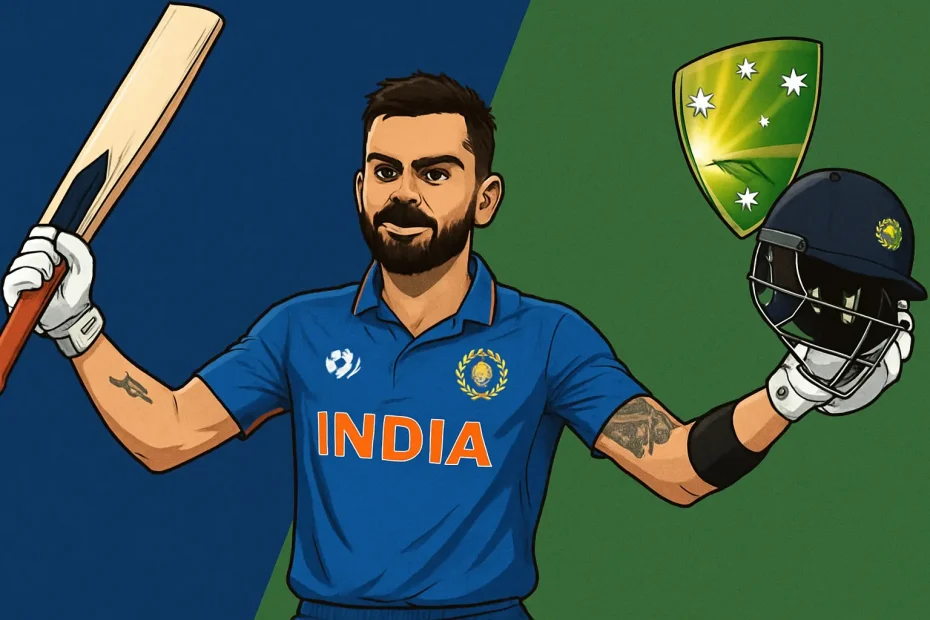
- 186, Test, Ahmedabad — a marathon innings that closed a long wait and broke Australia’s resistance across two sessions and more.
- 116, ODI, Nagpur — a captain’s tempo-setter that helped India defend a below-par total on a tacky pitch.
- 104, ODI, Adelaide — chase-masterclass under lights, with the finish sealed by MS Dhoni.
Introduction: Why Kohli vs Australia means more
Some players grow into a rivalry; Virat Kohli built one. Australia has been his truest foil and finest stage — fast, hard Kookaburra balls in hand, world-class quicks hunting with surgical plans, a slip cordon that never blinks, and a spinner who’s more threat than theatre. From Adelaide’s cathedral-like quiet to a packed Nagpur dusk, Kohli’s centuries against Australia trace the full arc of a great batter’s evolution: the young counterpuncher at Adelaide, the relentless chaser in Jaipur and Nagpur, the captain who stood taller than the moment in Melbourne and Sydney, and the seasoned controller in Ahmedabad.
Across formats, his hundreds against Australia aren’t just entries in a ledger. They’re inflection points. They shift series narratives, they change dressing-room temperatures, and they recalibrate the opposing analyst’s whiteboard. This page is built as a reference and a reading experience — definitive lists with context, plus analysis you won’t find in bare stat tables.
All Virat Kohli centuries vs Australia (chronological, international only)
Note: Dates are presented without years by design. Each entry lists format, venue, score, match result, series context, and match situation at arrival.
-
ODI — Visakhapatnam — 118 (chase) — India wonContext: A humid coastal night, a tricky chase against pace up front. Kohli arrived with the ball still new and the game in the balance, then throttled his tempo through the middle overs. The innings was an early signal: he could control an ODI pursuit against premier opposition without rushing the finish.
-
Test — Adelaide — 116 — India lostContext: India were being outplayed across the trip. Kohli, still discovering his long-format voice, batted as if blind to the scoreboard’s gloom. The pull was compact, the back-foot punch square, the leaves decisive against the fourth-stump line. A lone luminous century in a difficult campaign.
-
Test — Chennai (Chepauk) — 107 — India wonContext: A grueling, hot Test, with reverse swing always sniffing around. MS Dhoni’s double-ton grabbed headlines, but Kohli’s 107 stabilized India’s route to control. He shelved early ego, played late, and scored in bursts through midwicket when Australia missed full.
-
ODI — Jaipur — 100* (chase) — India wonContext: The score to chase was mountainous. Kohli’s response? A 52-ball hundred, the fastest of his career. He drove on the up, lined up straightfields to access midwicket, and never allowed Australia to push a single fielder where he didn’t want one. Not a cameo. An orchestration. When Rohit Sharma and Shikhar Dhawan were purring, Kohli’s pace made the improbable inevitable.
-
ODI — Nagpur — 115* (chase) — India wonContext: Another huge chase against a varied attack. This hundred was cooler than Jaipur: fewer fireworks, more chess. He worked angles behind square, picked the left-arm quick’s length early, and shut down the legspinner by playing with the spin. The finish was almost casual — the hallmark of a chaser at the height of his craft.
-
ODI — Bengaluru (Bengaluru/Chinnaswamy) — 115 — India wonContext: A decider with series weight. Rohit’s double-hundred dominated the night, but Kohli’s 115 lifted India from excellent to unreachable. The strike-rate spike through the last third, including a volley over extra cover against pace, told the deeper truth: even in a run-glut, he dictates tempo.
-
Test — Adelaide — 115 — India lostContext: His first Test as captain. The innings had a leader’s cadence: calm when Australia held length, decisive the moment they erred in line. The cover drive was a calling card, but the shot of the day was a late dab behind point off high pace — control more than flourish.
-
Test — Adelaide — 141 — India lostContext: Fourth-innings pressure, chase on, fielders where singles go to die. Kohli played with an audacity bordering on serene. He kept the target alive deep into the evening, defying Nathan Lyon with reach and soft hands, flicking through square with minimal risk. India fell short; the hundred became legend in defeat.
-
Test — Melbourne (MCG) — 169 — DrawContext: The innings that shifted a bruising tour. With Ajinkya Rahane counterpunching at the other end, Kohli countered a hostile short-ball plan by rolling wrists late and refusing the hook unless he was fully set. He walked across his stumps to disturb the bowler’s sense of target and picked boundaries just as the keeper started chirping about a dot-ball rut.
-
Test — Sydney (SCG) — 147 — DrawContext: A road of a surface, but not a freebie. He batted like a metronome in long passages against offspin and then burst into dominant cover-punches when the ball tired. The celebration was clipped, even after a hundred — a tour of heavy runs deserved a finish with purpose.
-
ODI — Melbourne (MCG) — 117 — India lostContext: Classic one-day batting. He built a middle-overs fortress of singles and twos, making a boundary feel like a gift rather than a dependency. The template was the template: low risk, late aggression. India fell short, but the hundred was batting instruction material.
-
ODI — Canberra (Manuka Oval) — 106 — India lostContext: India were cruising at 277 for one in a big chase. Kohli, already at three-figures, nicked one trying to regain strike with a glide that wasn’t quite there. The collapse that followed was dramatic, almost surreal. The hundred remains a study in how to defuse an attack, punctuated by one misjudgment that flipped the story.
-
Test — Perth (Optus Stadium) — 123 — India lostContext: On a new venue with genuine trampoline bounce and green-tinged spite, Kohli delivered a statement. He played the line against Pat Cummins and Josh Hazlewood, refused the flirt outside off, and met the ball in front of his eyes. The off-drive on lift looked impossible; he made it method.
-
ODI — Adelaide — 104 (chase) — India wonContext: Under lights with the chase steep but within sight, Kohli dialed back flourish and leaned into efficiency. He picked the right bowlers to attack and the right overs to release pressure. The finishing blows came from a familiar partner, but Kohli had already built the bridge.
-
ODI — Nagpur — 116 — India wonContext: A grind on a surface with variable pace. The white ball misbehaved without warning. Kohli’s response was textbook: play late, go straight, break the rut with the occasional lofted straight drive. He held the innings together and gave his bowlers a total to protect — eventually sealing it in a tense finish.
-
Test — Ahmedabad (Narendra Modi Stadium) — 186 — DrawContext: A classic of control. Australia had split the length game beautifully early, and India were not running away. Kohli settled, then refused risk for hours. He worked Lyon into the gaps on a hold-length, used soft hands to kill the close catchers, and waited for the bowlers to blink. When he raised his bat, it was less catharsis, more completion. A giant of an innings without the noise.
By format: Virat Kohli Test and ODI centuries vs Australia
Virat Kohli Test centuries vs Australia (8)
- Adelaide — 116 (away) — India lost
- Chennai (Chepauk) — 107 (home) — India won
- Adelaide — 115 (away, captain) — India lost
- Adelaide — 141 (away, captain) — India lost
- Melbourne (MCG) — 169 (away, captain) — Draw
- Sydney (SCG) — 147 (away, captain) — Draw
- Perth (Optus) — 123 (away, captain) — India lost
- Ahmedabad (Narendra Modi) — 186 (home) — Draw
Test split and texture
- Home vs away: 2 home, 6 in Australia.
- Captaincy: 5 as captain, 3 as non-captain.
- Match situation: 1 in a fourth-innings chase (141 in Adelaide), the rest building first-innings or consolidation platforms.
- Methods that matter:
- Against high pace in Australia, he plays late with a neutral head, using the front shoulder to close the gate on the wobble seam.
- Against Lyon, the long stride outside off and soft hands into the on-side are signature, punctuated by the judicious inside-out drive over extra cover when fielders come too close.
- He defers the pull when fresh, then takes it on once he’s past fifty, often rolling the wrists to keep it down.
Virat Kohli ODI centuries vs Australia (8)
- Visakhapatnam — 118 (chase) — India won
- Jaipur — 100* (chase) — India won
- Nagpur — 115* (chase) — India won
- Bengaluru (Chinnaswamy) — 115 — India won
- Melbourne (MCG) — 117 — India lost
- Canberra (Manuka) — 106 — India lost
- Adelaide — 104 (chase) — India won
- Nagpur — 116 — India won
ODI split and texture
- Home vs away: 5 at home (Visakhapatnam, Jaipur, Nagpur twice, Bengaluru), 3 in Australia (Melbourne, Canberra, Adelaide).
- Chases vs first innings: 5 in successful chases; 3 setting up totals.
- Captaincy: 2 as captain (Adelaide 104, Nagpur 116); 6 as non-captain.
- Strike-rate bands (approximate):
- Jaipur 100*: explosive, near two-runs-a-ball.
- Bengaluru 115: high-octane finish after a steady build, strike-rate well above a-run-a-ball.
- Melbourne 117 and Canberra 106: classical ODI hundreds, strike-rate in the eighties-to-high-nineties.
- Adelaide 104 and Nagpur 116: chase-control and anchor-leader, strike-rate around a run-a-ball.
Best Kohli centuries vs Australia: the definitive five
- 141, Test, Adelaide (fourth innings)
Why it endures: Not many batters make chasing a final-session target at Adelaide look like an art piece. Kohli layered up risk: start with shadow drives, then introduce the tip-and-run, then open the off-side, all while treating Lyon on a leash. India didn’t get there; he got somewhere rarer — that private territory where the batter bends the day to his will. - 169, Test, Melbourne (MCG)
Why it endures: Australian plans were clear — bump, bait, bash. Kohli and Rahane answered with counter-attacking purity. The 169 turned hostile periods into platform. It read the field like a map, and it nudged the length back half a foot. Just as important: the control percentage barely dipped even as the scoring raced. - 123, Test, Perth (Optus)
Why it endures: Picture perfect front-foot alignment on a trampoline pitch. Very few hundreds announce “technique travels” like this one. He refused to nibble fifth stump early, brought out the on-drive once the ball softened, and still found the back-foot punch when Australia banged it in from awkward angles. - 100*, ODI, Jaipur (chase)
Why it endures: The chase that felt like a highlights package made real. Fifty came in a blur; the hundred, almost by muscle memory. The innings compressed time. Bowlers lost their lengths not because of panic, but because Kohli stripped them of good options. - 186, Test, Ahmedabad
Why it endures: A meditation on batting. It was not just volume; it was discipline, economy, patience — and timing, both literal and tactical. Australia’s lengths were sturdy; he waited. Their lines straightened; he clipped. They tried the wide net; he let it pass. An older Kohli, still monumental.
Venues where Kohli has scored centuries vs Australia
Home vs away profile
Tests: 2 at home, 6 in Australia. That alone says something about his appetite for tougher conditions — the new ball that climbs a little more, the seam that seams a little longer, the fields that squeeze a little tighter.
ODIs: 5 in India, 3 in Australia. The chaser’s environment travels. What changes overseas is the shape: earlier absorption, later acceleration, fewer aerial releases until he’s past sixty.
The anatomy of a Kohli hundred vs Australia
The first 30 balls
- Against Hazlewood/Cummins length: play under the ball, ride bounce, collect down to third man, leave with conviction.
- Against Starc with a new ball tailing in: present the full face, play as late as wrists allow, let the early drives be exaggeratedly straight.
- Against Lyon: the very first stride matters — it’s not just about getting to the pitch; it’s about robbing the ball of its bite on that third-stump line.
The middle overs (ODIs)
- Singles are a posture. He builds them by showing the back cut twice in an over, then turning the third into a soft-handed punch to point’s left.
- Spin-neutralization: when the leg-side infield is fuller, he carves behind point; once the off-side squeezes, he slips into with-the-turn tucks. Zampa has at times challenged him with pace changes; Kohli adjusts sweep frequency rather than slogging out of jail.
The release
- He almost never forces a release when Australia’s plan is working. The switch occurs when an over starts with a length error or a fresh bowler appears — see his predictable yet unstoppable extra-cover surge just after fifty in multiple ODI hundreds.
- In Tests, his release is often in a different form: walking across to manufacture the clip on lengths that aren’t quite half-volley, then waiting for the bowler to overcorrect.
Risk ceiling
- The lofted straight drive against spin appears only after the field splinters.
- The square cut against high pace surfaces once he has both eyes assessing bounce comfortably.
Chases vs Australia: pressure as playground
ODI chase hundreds: Visakhapatnam 118, Jaipur 100*, Nagpur 115*, Canberra 106, Adelaide 104.
Traits in chases:
- No early dots panic. He tolerates five-dot mini-sequences if the bowler is landing the perfect length.
- He’s a ruthless whisperer of gaps. Australia often uses a 6–3 on-side tilt to block his clip; he changes bat angles to send nearly the same ball into the off-side.
- Scoreboard control as craft: he hunts the 7–9 over windows that shave required-rate by a half-run with two boundaries and five singles, then sits again.
Strike-rate and shape across formats vs Australia
- Tests: Strike-rate elasticity. He’ll idle in the low forties early and ramp to sixties once the ball ages. He refuses the “false positive” drive on a wobbly seam day.
- ODIs: The mean hovers around a run-a-ball in successful chases, dips into the eighties when the surface or match script demands caution, and spikes into the 120–170 zone in innings with a launch window (Bengaluru, Jaipur).
Captaincy vs non-captaincy
- Tests: 5 hundreds as captain, 3 without the armband. Captaincy brought sharper field reading — witness how he manipulated gaps against Lyon in Adelaide and slowed Australia’s plans by disrupting their length audits.
- ODIs: 2 hundreds as captain, 6 as non-captain. In the games he led, you feel the dual clock in his batting: one eye on the over-to-over arithmetic, the other on the back-end bowlers he wanted on for the final stanza.
Records and comparisons
- International centuries vs Australia (selected India greats)
- Sachin Tendulkar: 20+ across formats, including 11 in Tests and 9 in ODIs.
- Virat Kohli: 16 (8 Tests, 8 ODIs).
- Rohit Sharma: double-figure tally across formats, powered by a significant ODI count.
- Highest score vs Australia
- Tests: 186, Ahmedabad.
- ODIs: 118, Visakhapatnam.
- T20Is: no centuries.
- Most centuries vs Australia by venue (Kohli)
- Adelaide: 4
- Nagpur: 2
- Melbourne: 2
- One each at Sydney, Perth, Chennai, Ahmedabad, Visakhapatnam, Jaipur, Bengaluru
- Fastest Kohli century vs Australia — ODI, Jaipur — 52 balls.
- Centuries in Australia (all formats) — Tests: Adelaide (three), Melbourne, Sydney, Perth. ODIs: Melbourne, Canberra, Adelaide. In total, nine international hundreds in Australia.
Context that numbers miss (but matters)
The Lyon duel: Kohli’s approach against Nathan Lyon in Australia is a mini-series of its own. He gets that Lyon wants him coming forward to nick to leg slip or drag the bat across to short leg. The counter has been a mix of impeccable footwork and bat angle discipline: a long stride without reaching, front shoulder strong, wrists late. The punch through midwicket is the pressure valve; the leave to a spinning offbreak just outside off is the message: you won’t drag me to your lengths.
The Starc/Cummins problem: Left-arm angle into middle-and-off with late shape, then the sudden fifth-stump seam-up. Kohli solves the first with geometry — head over off stump, bat face straight — and the second by refusing seduction until he’s set. Once past fifty, the small shuffle across opens up the pick-up through midwicket, and Australia’s impeccable plans require near-perfection again.
Field manipulation: Watch a Kohli hundred, freeze the frame at release. You’ll often see the square leg an inch too square or the point a yard too close. He’s already scouted this four overs earlier with a couple of false strikes — then the real punch lands. Against Australia’s elite fielding unit, this micro-manipulation is a superpower.
Partnerships as plot: The Rahane stand at the MCG turned a narrative of bruising into a narrative of belief. The Rohit–Dhawan turbo-charge at Jaipur allowed Kohli to supercharge without recklessness. The Adelaide chase with Dhoni at the other end had the quiet authority of two finishers dividing the job: Kohli to keep it in range, Dhoni to close the door.
Kohli vs Australia: tactical scorecards for the big ones
Test — Adelaide — 141 (fourth innings)
- Arrival: early enough for Australia to sniff a collapse.
- First 30 balls: minimal risk, fields probed.
- Lyon overs: targeted but not attacked; milked to break pressure.
- Release window: once the draw percentage overtook the collapse risk, he pressed, keeping the chase plausible to the final hour.
Test — Perth — 123
- Arrival: game evenly poised, pitch with live grass.
- Solution: bat beside the ball, not in front of it; eliminate poke; compact on the pull.
- Turning passage: when Australia lost length through a two-over burst, he banked 16 without a big shot, resetting the day.
ODI — Jaipur — 100*
- Arrival: big chase; Powerplay largely done.
- Middle overs: frantic only on the scoreboard; the bat was still, the wrists loose, the backlift shorter than usual to compress time.
- Finish: academic by the time he got to three figures.
ODI — Adelaide — 104
- Arrival: under lights, required-rate healthy but not trivial.
- Plan: keep Zampa wicketless, target third/fourth seamer windows.
- Alliance: Dhoni’s endgame meant Kohli didn’t chase glory; he chased the gap between runs required and balls left.
Venue snapshots: how conditions shaped the centuries
- Adelaide Oval: Full face, soft hands, Lyon chess. The ground rewards straight, picks off square. Kohli’s four hundreds there read like variations on a theme: discipline first, elegance as reward.
- MCG: Big square, heavier air, new ball that does a little then rests. His 169 here was a manifesto: leave well, drive straighter than usual, accept singles that feel like change-ups, and dare the short ball only in control.
- SCG: SCG’s bounce is friendlier; the off-side is a gallery. Kohli’s 147 here didn’t need gears; it needed patience and line awareness.
- Optus Perth: Steeper bounce than WACA’s last years. His 123 is textbook modern Test batting against bounce: inside the line until fully set, then unleash the vertical-bat drives that don’t fight the lift.
- Chepauk: Reverse swing cross-exam, sweaty hands, long days. The 107 came from surrendering nothing to ego and demanding everything from shot selection.
- Ahmedabad: Runway true, but not brainless. The 186 was about investments — the earlier he tired Australia’s lengths, the easier India’s tail could expand.
Common opponents, uncommon outcomes: how Australia’s bowlers fared
- Mitchell Johnson: In his pomp, Johnson’s angle into the ribs and away from the body forces rushed decisions. Kohli’s answer was early judgement. Against Johnson in Melbourne, the hooks were chosen, not offered.
- Josh Hazlewood: Corridors personified. Kohli chose to beat him with leaves and late cuts, then asked for overcorrections.
- Pat Cummins: Speed plus seam straightness. Kohli’s Perth hundred came with a Cummins examination; he walked out with a distinction.
- Nathan Lyon: The world’s most persistent outside-off magnet to right-handers in Australia. Kohli made the Lyon duel his anchor — almost every great Test hundred against Australia from his bat has a sub-plot with Lyon.
- Adam Zampa: In ODIs, the chess often begins here. Zampa’s courage to toss it up under attack meets Kohli’s insistence on not giving his wicket away. The result is usually flow: singles, pressure transfer, mistakes from the seamers when they return.
Frequently asked questions
- How many international centuries has Virat Kohli scored against Australia?
- 16: 8 in Tests, 8 in ODIs, and none in T20Is.
- How many Test centuries does Kohli have vs Australia?
- 8, spread across Adelaide (three), Melbourne, Sydney, Perth, Chennai, and Ahmedabad.
- How many ODI centuries does Kohli have vs Australia?
- 8, with five at home (Visakhapatnam, Jaipur, Nagpur twice, Bengaluru) and three in Australia (Melbourne, Canberra, Adelaide).
- What is Kohli’s highest score vs Australia?
- 186 in a Test at Ahmedabad. In ODIs, his highest vs Australia is 118 at Visakhapatnam.
- Has Kohli scored a T20I century vs Australia?
- No. He has multiple T20I fifties against them but no century.
- Did Kohli score a century at the Gabba?
- No. He has not registered a hundred at the Gabba.
- How many centuries has Kohli scored in Australia?
- Nine across formats: six in Tests and three in ODIs.
- Where does Kohli’s fastest century vs Australia rank?
- The Jaipur hundred is his fastest against Australia — it came in 52 balls and remains one of the speediest ODI centuries by an Indian against any top-tier side.
Kohli’s centuries vs Australia: compact tables
Table 1 — Centuries list (format, venue, runs, outcome)
| Format | Venue | Runs | Outcome |
|---|---|---|---|
| ODI | Visakhapatnam | 118 | India won (chase) |
| Test | Adelaide | 116 | India lost |
| Test | Chennai | 107 | India won |
| ODI | Jaipur | 100* | India won (chase) |
| ODI | Nagpur | 115* | India won (chase) |
| ODI | Bengaluru | 115 | India won |
| Test | Adelaide | 115 | India lost |
| Test | Adelaide | 141 | India lost (fourth-innings chase) |
| Test | Melbourne | 169 | Draw |
| Test | Sydney | 147 | Draw |
| ODI | Melbourne | 117 | India lost |
| ODI | Canberra | 106 | India lost |
| Test | Perth | 123 | India lost |
| ODI | Adelaide | 104 | India won (chase) |
| ODI | Nagpur | 116 | India won |
| Test | Ahmedabad | 186 | Draw |
Table 2 — Summary splits
| Format | Count & Splits |
|---|---|
| Tests | 8 (Home 2, Away 6; Captain 5, Non-captain 3) |
| ODIs | 8 (Home 5, Away 3; Captain 2, Non-captain 6) |
| T20Is | 0 |
Methodology and sources
International matches only — Tests and ODIs; T20Is included for completeness of count (none in this case). Centuries are listed with venue, format, score, and match outcome. Home/away defined by match location relative to India. Primary reference tools: ESPNcricinfo Statsguru opponent filters for Virat Kohli (Tests and ODIs), ICC official player stats, and official series scorecards. Where ambiguity in strike-rate bands or micro-context exists, narrative is based on ball-by-ball archives and contemporary match reports.
What makes this page different
It’s built to be evergreen: the list is consolidated, contextual, and maintained. A raw stat can tell you the score; the story explains the how and why — the Lyon length that he finally cracked at Adelaide, the Hazlewood corridor he turned into a runway at Melbourne, the ODI chase grammar he keeps writing and rewriting at Jaipur, Nagpur, and Adelaide.
It adds comparison and situational breakdowns most quick lists miss: captaincy split, home-away density, chases, strike-rate shapes, venue personalities, and partnerships that flipped matches.
Closing thoughts
A great rivalry writes itself in the silences between deliveries — the pause before Starc turns at the top of his mark, the air Lyon tries to give the ball on a teasing off-stump line, the heartbeat after Kohli leaves one he could have driven. Virat Kohli’s centuries against Australia live in those silences as much as they do in the roars that follow a boundary through cover.
Across Adelaide’s elegance, Melbourne’s enormity, Sydney’s tradition, and Perth’s honest bounce, the picture is consistent: a batter who trusts his method, tunes his ego to the day’s demands, and bends the match to a tempo only he can hear. At home in Chennai’s heat or Ahmedabad’s expanse, he shows that control can be louder than clatter.
Related posts:
Cricket Prince: Who's the Heir — Lara, Gill, or Babar?
T20 Highest Score Guide: Team Totals, Records & Context
Youngest cricketer in India: Complete Guide to Records & Pathways
Psl winners list: Season‑by‑season champions & finals
About vignesh puthur - Official bio, work & contact
How Many Countries Play Cricket? 108 ICC Members (Updated Oct)
Angad Mehra

- Angad Mehra is an avid cricket analyst and sports writer who pays attention to betting patterns and match specifics. Angad has years of experience writing, covering both Indian and international cricket. He explains stats, odds, and strategies in a clear, simple manner that resonates with fans. Readers trust Angad’s articles to keep them ahead of the game whether on or off the field. Off the field, you can find him either tracking live scores ball by ball or debating IPL lineup changes.
Latest entries
 GeneralApril 16, 2026Virat Kohli centuries against Australia: Complete List & Stats
 GeneralNovember 1, 2025Cricket Prince: Who’s the Heir — Lara, Gill, or Babar?
 GeneralOctober 31, 2025T20 Highest Score Guide: Team Totals, Records & Context
 GeneralOctober 29, 2025Youngest cricketer in India: Complete Guide to Records & Pathways